Monday, 23 June 2014

The new horse; Cervelo R5

-->

“ ’Twas Mulga Bill from Eaglehawk that caught the cycling craze.  He turned away the good old horse that served him many days.  He dressed himself in cycling clothes, resplendent to be seen.  He hurried off to town and bought a shining new machine.  And as he wheeled it through the door, with air of Lordly pride…he quietly wondered whether it was going to live up to the hype”.

OK, I made the last bit up (with apologies to Banjo), but that’s probably what most of us ponder at some point during the transaction of sale.

The good old horse, of course, was a Chinarello masquerading as a Wombat.  After carrying me for 3 years and 44000 km I thought it time to put it out to pasture.  Maybe I’ll keep it stabled for rainy day commutes.

The shining new machine was going to be something more matte-finish and comprising mostly element 22 (that’s Ti, for you non-chemists), but ultimately budget ruled such exotica out (for now, at least).  So I opted for element 6 again, but stuck with a non-glossy finish in the form of a Cervelo R5, 2013 vintage, kitted out with Ultegra 6800 11 spd bits, Rotor crankset and Fulcrum Racing 5.5 wheels.  Unusually, for this color challenged individual, I preferred the 2013 finish (grey with red highlights), to the 2014 R3 at a similar price point (gloss finish and blue highlights).  The 2014 R5 (which is only sold with Dura-ace) was about $3000 out of reach.

A few of you likely to be reading this are in the market for new rides, so I thought I’d share my thoughts.

Weight.  Light, but perhaps not as featherlight as expected.  Without pedals, cages, or paraphernalia we are talking 7.2 kg (versus ~ 7.8 for the equivalently stripped down Wombat).  I should disclose that this was with a temporary 400 ml seatpost comprising element 13, which post weigh-in has been swapped for a 350 ml version constructed from element 6.  The main contributor to weight, however, is a Clydesdale wheelset.  Just shy of 1700 g for the rear wheel alone (including rubber, QR and cluster), which is despite being shod with paper thin Vittoria Diamante Pros (lipstick on the pig) .  That's even heavier than my handbuilt 32 spoke old-faithful shod with heavier Contis.  The wheels are certainly the standout weakness of the package, but should serve nicely as bash-about commuters.  I’ll save the HEDs for weekends once I acquire cluster number 2.

Ride quality.  I was expecting the bike to have a bit more pep than the Wombat, but I honestly wasn’t expecting the package to be quite this good.  The snap, out the saddle, is astonishing.  One profound difference is the stiffness in the front end.  The Wombat wasn’t sloppy by any means, but stiffness-wise, the front end of the R5 might have been caste from iron (element 26!).  That said, the handling is weightless yet not jumpy, there is zero road buzz, and the whole experience is soft on the hands, even though the flat-top bars (3T ErgoNova Team – element 6) are much thinner than the mega plush ITMs I’m used to (element 13 wrapped in element 6).

Accompanying the rigidity of the front end is what’s happening (or not happening) under your feet.  Mega stiff, in spite of the fact that there must exist squirm in the wheelset. 

This stiffness is due to some engineering advances that trump the outboard bottom bracket format I’ve been riding.  To my mind stiffness is heavily influenced by both the diameter of the crank axle and the width between the bottom bracket touch-points that interface frame and crank.  The standard crank axle diameter used by Shimano is 24 mm.  The diameter of the Rotor axle is 30 mm.  Fatter diameters should make for stiffer axles

The outboard bottom brackets found on most bikes (until more recently) are typically set 68 mm apart (the 68 mm standard!), symmetrically positioned about the central axis of the frame.  Some bikes maintain the 68 mm spacing but swap outboards for press-fit bearings, fattening the frame and stiffening the ensemble in the process.  This is the direction Cervelo have gone, using oversized press-fit bearings housed 79 mm apart, but asymmetrically biasing them to use all of the available space on the LHS of the bottom bracket area – the space which on the drive-side is taken up by clutter in the form of chainrings.  The result is the so-called BBright standard.  Hence, not only are the contact points 11 mm further apart, the fame itself is 11 mm wider on the non-drive side than one utilizing outboard bearings.  Both contribute to extra rigidity. Additionally, whilst the crank spider on a Shimano groupset curves inwards to place the chainrings back over the top of the outboard bearing shells, the Rotor rings project straight out, perpendicularly, from the axle (again, lighter and stiffer – so they say).

I was initially a bit peeved that I wouldn’t be carrying the complete Shimano  Ultegra 6800 groupset (the 11 spd progression from the 6700 10 spd version I’ve been running), but I was advised not to opt for the adapters and stick with the Rotor crank and axle assembly.  Now I feel why.

This thing is amazingly responsive – you can hear the rear tire suffering against the road surface, even with el cheapo wheels in tow.  I can’t imagine you’d want the thing any stiffer, although the spin doctors claim that the 2014 version is 20% stiffer again.  How easily one would notice this difference on top of what is already super stiff is another question.

But, as is often the case, there are a few problems.  All that stiffness is also going to be sampled by ones posterior.  And that is certainly the case.  Whilst at speed I do indeed get the impression that corrugations are dampened, I was expecting the bike to be a tad more comfortable, given its cobbled-classic pedigree.  I’m just glad I didn’t pick up a second hand S5 a year ago, as the S5s are meant to deliver a considerably harsher ride than the R series (Chris affectionately calls his, “The Boneshaker”)

In its defense, there are some reasons for harsh ride.  Firstly, while the guys at the shop were adamant my anatomical dimensions fit the “54”cm frame (vs the 51 or 56), this required swapping out the heavily set-back FSA seatpost supplied to a straight post in order to get the position I wanted.  In recent years I’ve moved my road position forward to match that of my MTB, and there are all sorts of advantages in XC racing to having ones arse in a more forward default position.  Even though the post diameter is a relatively compliant 27.2, and at an angle dictated by the compact frame geometry (73 degrees), a straight post is never going to afford the generous flex inherent in a set-back post.  Perhaps the ride will be kinder now that the carbon post is installed, although I’d be surprised if this alone makes much difference.

Second reason.  I was glad that the bike came with a Fizik saddle of choice.  I opted for my favoured Arione (long and flat).  What I didn’t realize at the time was that such saddles no longer come in simply 2 options – rails made of element 6 or 26.  Now there are about 10 different versions.  This particular Arione  (element 26 rails) is branded “CX”.  I’ve since discovered that this means they started with an Arione, removed most of the foam stuffing and then sewed the thing back together.  Not happy, and if my sit bones fail to acclimatize to such minimal padding I’ll be ordering one of the less racy versions.

Whilst the excellent handling fills one with confidence, one point of difference in the handling department is a bit of “toeverlap”, courtesy of the wheelbase being 1 cm shorter than what I’ve been used to.  Should only be an issue navigating footpaths.  I’m yet to pilot the R5 on proper sustained descents just yet, although at no point has the handling felt twitchy.

Whilst on quibbles – one last one, and potentially it’s a biggy.  In my humble opinion, the frame has an entirely preventable and very disappointing flaw. 

The last 2 frames I’ve ridden have been low end, admittedly, but they had, what I viewed as poorly designed rear drive-side dropouts.  That is, the bit that holds the derailleur hanger.  The hanger (element 13) bolts directly to the frame, and the QR skewer clamps over the top of this.  The axle, by contrast sits flush against the other side of the carbon dropout.  When the QR skewer is tensioned, flexion in the carbon dropout results in subtle movement in the derailleur itself, most pronounced at the bottom derailleur pulley.  To my mind, at least, if you want bombproof shifting, having a rock-solid derailleur position would be paramount.

Fully aware of what I didn’t want, I opened and closed the QR on the bike on the showroom floor.  No movement.  That was all I wanted to see.  When I got it home, however, and applied QR tension I’m accustomed to, movement was present.  Not happy.  All that engineering and they can’t seem to get this part right?  Was it just my frame in question?  Appears not.  Same dropout for both the R and S series, including top-end 2014 models. Apparently, Cervelo doesn’t consider it to be a problem nor limitation as the dropouts have remained unchanged for years.  Maybe I’m overreacting.  When I mentioned this to the guys at the shop they just shrugged and said that the Cervelos have always had “soft” dropouts.  They then asked me whether I was having any trouble with shifting.

Groupset.  I don’t know what impresses me more – the superb ride quality or the simply stunning shifting.  Actually it just might be the shifting.  The 11 spd Ultegra is just sublime.  As well as going from 10 to 11 spd, the most striking difference between 6700 and 6800 series is the redesigned front derailleur.  Throwing to the big ring requires almost no effort at all.  And I love the new feature of being able to trim the big ring position to accommodate spending more time with bigger cogs on the back.  I’ve gone from 39/53 rings and 25/12 cluster, to 36/52 and 28/11 – an expansion at both ends of the gear spectrum.  Necessarily I’ll be spending more time in the big ring and the trim features of the front derailleur make this easy peasy.  Love it!  600 km in and despite the rear wheel having gone in and out half a dozen times (with no doubt variable clamping tensions), the shifting has not missed a beat.  Just stunning.

So, that's about it.  Sublime machine in spite of what I perceive to be a sub optimal rear dropout.  The real proof, however, will be how “sensations” are after 10000 clicks.  By that stage I might even have another 3peaks under the belt.  Can’t wait.


Wednesday, 21 May 2014

Chocolate Footprints – Taree 7hr 2014

-->
Drove up on Sat.  A few easy sighting laps (in the full light of day, this time) reveal the course to be essentially the same as 2013.  What a lovely circuit.  Like last year – but even more groomed, and buffed preposterously clean by leaf blower – finally a purpose for such obnoxious contraptions.

Caught up with Varx at Port Mac in the late arvo.  Then back to Taree for steak, chips, and a couple of light beers.  Only a phone call from The Mudge saves me from a stout chaser.  In tent by 9:30.  Interweb magic allows an update on how Giles is faring in the NorthFace100.  Ahead of schedule is a good sign. Can’t sleep so intermittently follow the Giro on CN.

Best bird came early – Russet-tailed Thrush on call from the sleeping bag.  A first.

Super cold in the am (= sleeping bag a bit thin?).  Slumber visions of starting in thermals and long fingered gloves prove unfounded.  It heats up fast, despite the sun struggling.  I start without both, or any gloves for that matter (not the worst thing I could have forgotten).

Usual bottleneck after the opening fire-road gallop.  Like cyclocross, in mountainbiking the sprint is at the start.  A handicap, but I struggle holding the wheel as it is.  I think I’m faster once I get my eye in, but then fatigue blunts that anyway.  Luckily I still enjoy my version of flow.

I settle into a rhythm.  Someone on my wheel knows my name.  We chat.  It’s the rapidly improving Cory Dimmer – also in my category.  We swapped positions and polite banter a few times last year in the hilly round at Orange where he won the Clydesdale prize (= fastest rider with combined weight (including bike) of 110 kg).  Big, strong and with superior skills.  This essentially flat course better suits him.  I’m holding him up but he explains he’s happy on my wheel, learning to “pace thyself”.  The track is a real joy to ride, especially with good company.  I put in the odd subtle dig, but am easily matched.  Focus on the long game.

Fourth time through transition and the p.a. reports that Cory is running 5th in Masters.  I’m 2 meters in front of him, which means I’m running 4th, or thereabouts.  Half way through the next lap I continue our conversation only to discover that Cory’s been replaced by someone else.  I later found out that Cory had to ease off as his front brake caliper rattled loose on the fork, which he tightened at the next pit. 

I ponder whether perceived “squishing-out” on corners is loss of pressure.  Was 24 psis in the rear too few?  Or was there a more obvious problem.  Prior to the start the rear wheel had 41 bleed points (I counted them), including a freshly removed thorn.  Should I don fresh rubber before or after I inflict a slash that sealant won’t plug? 

Maybe two laps later Master Welch, who this season is running pairs with Mike Israel (thank goodness on both counts!), informs me I’m running third with McAvoy 7 minutes up the track, leaving 3 hours to catch him.  I squeeze out two quicker laps.  The second will be my quickest for the day.  Who in tarnation am I kidding?

Myself, obviously.  I’m now having splutterings in the engine and gut departments.  Feeling periodically bloated even though I’m drinking less than usual.  Must be the wrong combination of potions.  I spend the last 2 hours feeling toasted.  No hint of cramp, just trashed. 

Not my best outing (too much of life on the beer), but an enjoyable days racing none-the-less.  McAvoy finished 15 min ahead, and that Central Coast hard man, Adams, almost lapped me to take the category and 4th outright.  I’m bumped to third (11th outright) because that ever-young James is now granted his own Supermasters category.  He almost lapped me as well!  Bridgland, who was running 3rd for a good chunk of the day also had a mechanical after which he struggled to find the speed he’d shown earlier in the piece, finishing 10 min adrift.  Dimmer finished only a few mins behind him.  So many finishers on 14 laps!

At the pointy end, McDonald and English (16 laps) stormed past me on my 6th outing.  At this point it was shadow boxing and occasionally gritted teeth.  They next passed me on my 12th, but by this stage English had a few minutes buffer.  Smooth as silk, to Ed looking a little ragged.  I’m also ragged, but crawling by comparison!  Apparently, with three to go it was agreed that the honeymoon was over and it was time for full-blown fisticuffs with a not totally surprising outcome, although one gets the impression that Ed is slowly closing the gap.  Hats off to both.

Another fine-vibe edition of Chocy Foot.  Looking forward, albeit with trepidation, to doing it all again at what is promised to be a more white knuckle experience at Mogo.


Monday, 12 May 2014

Shimano FC 6700 crank fail

-->
But perhaps not the kind you'd expect.  

Whilst trundling to work with Lawrence last week i turned onto the pedestrian overpass at the convergence of Victoria Rd and the ANZAC bridge when something went clunk.  Not just the grinding of gears.  Both feet found themselves in the down position.  Bicycles don't work that way.  This was serious.  Even though the Wombat has now carried me for 42K kms, never expected I'd be adding cranks to the list of things I’ve replaced on it.  Somewhere, hidden between the outboard bottom bracket bearings, the crank axle sheared.  Never seen this before.  Nor had the bike mechanic who just happened by and asked if he could help.  The incident did, however, facilitate a very pleasant stroll over the Darling Harbour walkway, something I've not done in daylight since I don't know when (thanks for the loan of the shoes, Lawrence).

Strangely enough, had I listened to Karma (or believed in such bunkum) I might have expected it.  Only the weekend prior I was in the St Albans beer garden imbibing the local drop and swapping Convict stories.  Just 30 meters away the post-podium lucky draw prizes were being distributed.  Name after name was being drawn, then discarded when the owner didn't pipe up.   Suddenly I hear my name called and return to the table with, you guessed it, a brand spankers crank set; FSA K-light hollow carbon cranks, albeit 175 mm (a fraction long) and sporting mtb tooth configuration (40/27).  Quite happy with XTR really, and in any case not really designed for the road.

The scary thing is, only days before the fail I'd been doing the 3 valley loop with Chris.  We were both on the limit hanging on to a couple of A-graders along the Arcadia road.  Had the fail occurred during maximum effort I’m not sure I would have kept things upright.  A little disconcerting to say the least and makes me wonder what might be next?  Hence, time to accelerate the look for something new.


 FC 6600 (shiny, LHS) has a much thicker axle wall than the 6700 series which replaced it.  Hence, 6600 should do me for the time being.


Friday, 9 May 2014

Eighth time a Convict

-->
That sandstone stalwart of the NSW enduro season has played out for another year.  The Convict100 is the only 1-day race that makes me nervous, courtesy of numerous solid sections of rugga-bugga (too many to commit to memory) which are sure to stretch ones handling skills as fatigue sets in.  Although I can ride nearly all of it (there’s one rock step I can’t clear) riding the stepped downs at speed requires a certain bravado I lack.  This year, my 8th participation, I’d be having a crack on the 29er hard-tail, something I would have never contemplated till recently (the hard-tail part, that is).  Coupled with having acquired fewer kms in the tank compared to last year, this also provided the excuse to go softly-softly and just nurse myself round the course one rock step at a time.  That was the no-pressure plan.  Reality; it’s hard not to get carried away when the flag drops and the legs feel super.  And that’s exactly what happened.

The alarm chimes at 5:15 and immediately the pitta patta of rain reminds us of the dour forecast.  Fortunately, the rain ceases after 20 min.  This slight dabble of precipitation substitutes for the choking fog that usually sits in the valley.  The temperature is actually mild.  Lined up with hundreds of others in the starting chute, and feeling overdressed, Mr Welch kindly holds my bike whist I strip off my base layer and squish it into my pack.  Otherwise the backpack contains two liters of potion, with another two bottles on the frame.  Phil opts for the alternative strategy of a bottle on the frame (29er dually), one in the back pocket, and a pit stop en route.  We were both lucky to make the tail of the first non-elite wave.  Soon we are under way, and even on the opening dirt roads the big wheels feel decidedly faster.  I work my way through the field and settle in the top quarter as the bunch motors along, 4-5 abreast, at 40 km/hr.  

The opening pace doesn’t seem as quick as last year, but this isn't a bad thing.  Soon we make the left turn onto the paddock trails.  The first major climb of the day looms. Predictably, a few riders choke on the rubble when it steepens, forcing a conga-line of equivalent dismounts.  Phil was one of the few to buck the trend, muscling past the first choke-point, only to be uncoupled 5 meters later.  I succumb to running the bike, although manage to re-mount, maybe 50 meters on.  I sneak past Phil and by keeping the effort controlled am able to ride the rest of the climb.

The top gained, I find a rhythm – firm but not crazy. Pinch-climb followed by speedy run, over and over.  Piano over numerous water bars.  Soon the 28 km point arrives where the split occurs.  Well warmed up now and ready for the gnarl that is coming.   I tractor through a corrugated rock garden, then the next, then another, and so it goes for this arduous 10 km stretch, before finally we get a solid run down to the 50 km checkpoint.  My clock is at 2:16.  Three minutes slower than last year but not too far off the pace.  The legs still feel good.

Forced guzzling ensues over the next 5 km of gentle climbing before the next 10 km section of 3D sandstone.  Tiny twinges of cramp, but nothing too concerning at this stage.  Just measuring the effort to avoid wasting matches unnecessarily.  That's the key, for me at least.  Finally the first big descent arrives.  I motion another rider I've just passed by. Perhaps he'll show me the better line.  Soon he is out of sight.  Riders flash by on the side of the track dealing with punctures.  Well into baby-head-alley now, the tamest I've seen it.  Out of the jungle and onto a km of road before the canoe- bridge crossing.  This year I really nail it.  

Post-crossing I regain the tarmac with the clock at 3:10.  Exactly the same as last year!  Five km road sector.  Group of 3, then two.  My passenger gives me one brief pull but the rest is mine.  Cramp now a little closer to the surface. Finally I claw onto the switchbacks of the second big climb and feel like easing up a little.  Until I spy Phil, just a few ramps below me.  Even as I watch he dumps his companions of the road sector and is looking strong.  I’m sure he has my jersey on the radar.  It will only be a matter of time. 

Thirty km from home is too far to simply empty the legs. Kilometers tick by but I dare not look back.  I catch a few riders and we share the pace on the flat bits when not engaged in the numerous pinches.  The track has been freshly graded.  Hence, smoother than usual, but very soft in places.  We pass the marshal at the critical RHT signifying the top of the course and the end of the climbing.  Amazingly, I don’t think Phil has bridged yet.  Maybe he is tanking?  I hang on through the off camber-looseness that delivers one to the mega plunge back to the valley road.

Relieved to have the last technicality behind me I drill the road sector with a few hangers-on.  We all get bogged in sand before the final crossing of the Macdonald River, which is waded to keep drivetrains dry.  Two Ks to go.  On the last pinch my passengers get finish-line fever and punch for home. I’m empty and can’t quite bridge, limping home a hundred meters behind to stop the clock at 4:36:06, bettering my time of 2 years ago by 3 minutes (46th outright and 15th in the 40-49 bracket).  Phil rolls in just 90 sec back.  Apparently he hadn’t caught sight of me after all!

Anita rolls home just a few minutes later, finishing her first attempt at the 50 km course.  Unknown at the time she jagged 3rd in category.  Super effort!  She’s making a habit of picking up podiums at the first attempt.

The outright winner of the hundred was Canadian Cory Wallace, finishing just 7 seconds shy of the course record with a 3:47 and change.  Wow!  Only 8 riders (of 524) went under 4 hours, the last of which was the winner of my category  (mutton dressed as rabbit!), finishing 8th outright with an astonishing 3:59:43.  Congrats Mr Barnard!  Such is the quality of the field these days I would have needed to dump another 23min just to find the bottom step of the podium!  Still, I’m pretty happy with my effort, and seemed to pull up better than ever before.  Perhaps counter-intuitively, the back was fine and neither posterior nor even the palms of the hands seemed to have come through with any soreness or semblance of blistering.  Love that hard-tail!

Mikey, fresh off walking the Kokoda Track, was the last Soggy home (6:31) proving that hiking fitness doesn’t necessarily translate to an easy Convict experience.  Not having touched a bike for 2 months he always knew it was going to be a toughy!   Although no helicopters had yet been summoned we were getting a little anxious, and it was nice to see him home, and smiling…just…at least with beer, steak sandwich and chips at the ready. 

Word is the organisers are contemplating a course change for next year, however I’m hoping that the Jeckle and Hyde mix of smooth and rough remains as a unique yet standard testing ground for future editions.


Wednesday, 30 April 2014

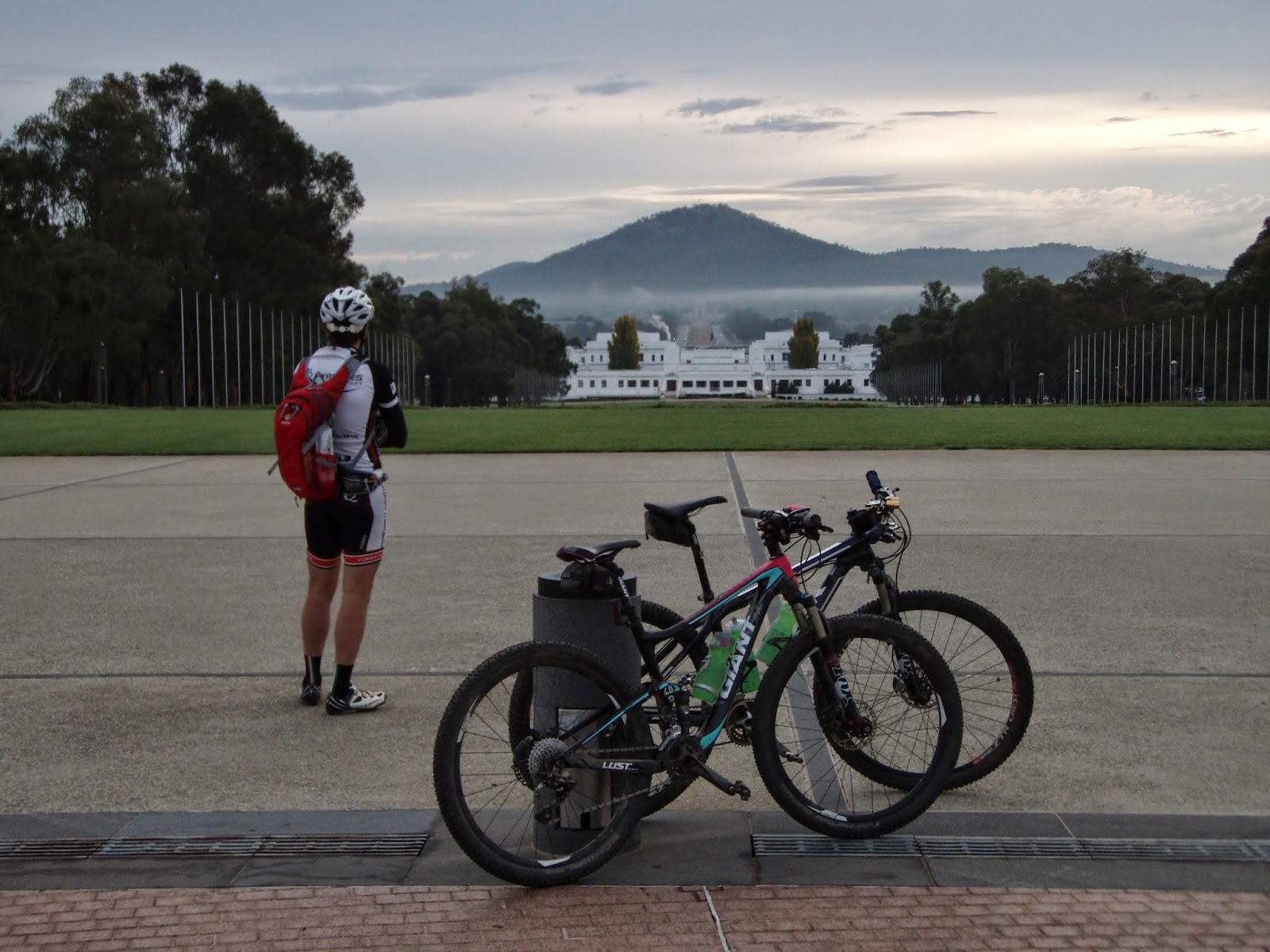
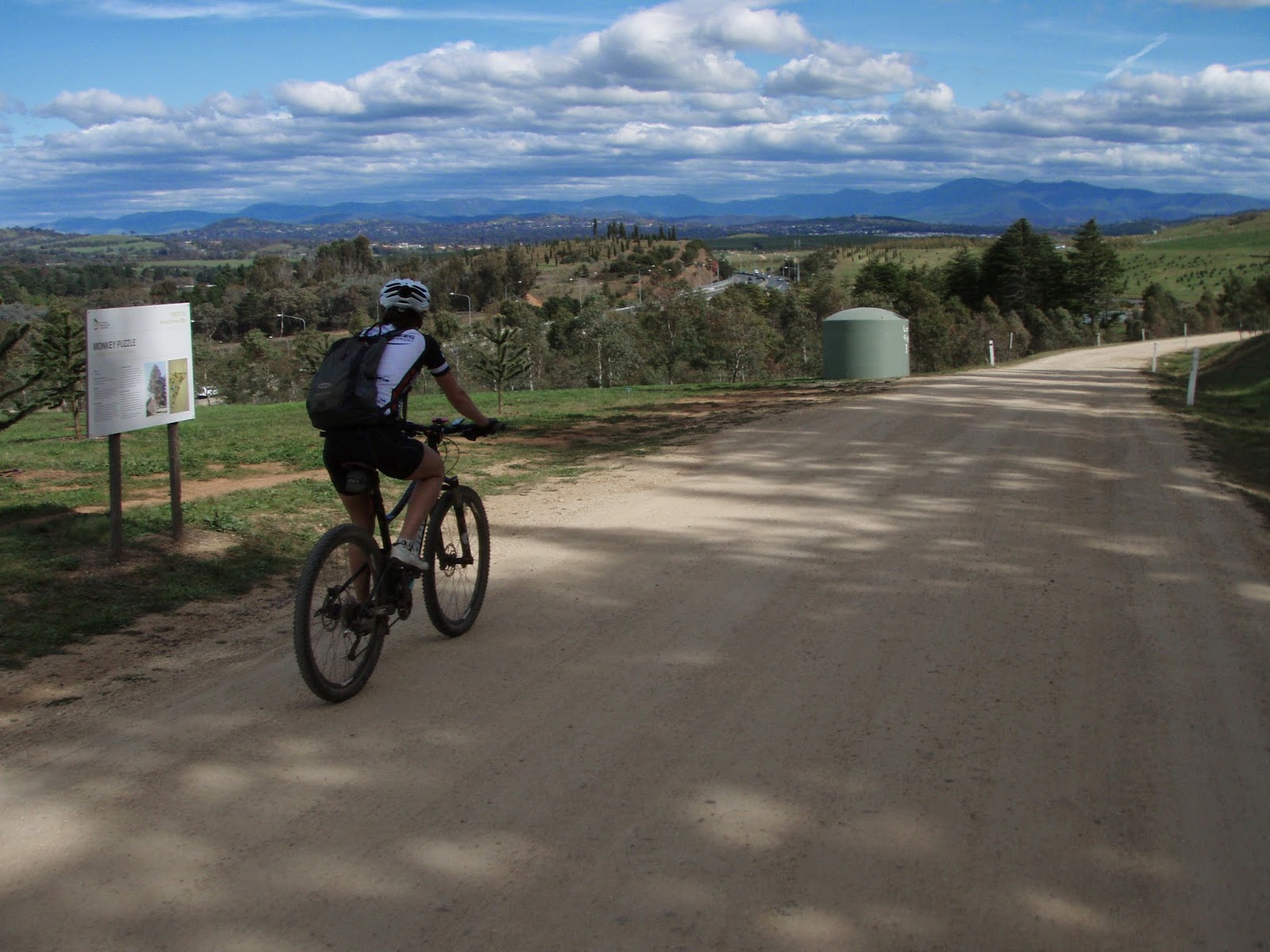
Canberra Centenary Trail - dawn till well after dusk


I knew this would be a long day, and that perhaps it should have been attempted a month or two ago, but finding a free weekend these days is sometimes not trivial.  In any case, the ANZAC day weekend loomed and we went for it.

The Centenary Trail was marked last year in commemoration of Canberra turning 100.  Intended as a trail which can be walked in 7 days or ridden in three, the trail starts at Parliament House, skirts the War Memorial, then soon has one at the scrubby base of Mt Ainslie before arcing in a wiggly anticlockwise 145 km loop along the perimeter of the built up areas (and beyond), before returning one back (eventually) to the flagstaff on the hill.

We packed the seven PDF trail maps, snacks and a few warmer items into backpacks and were rolling at 7 am - as early as we could muster even though sun-up was at 6:35.  Our hotel was 5 km from the start/end points (the big flagstaff), so we were always going to be looking at something close to 160 km for the round trip.  I was hoping we’d be done by sunset at 5:25pm.  Not being locals, actually studying the map would have made things a bit slicker and saved us a good hour due to navigational hiccups.  However, unsighted, it's hard to know which bits were going to catch us out.  In any case, a good dose of uncertainty adds to the adventure.

The Centenary Trail does a great job in showcasing some of the best of what the ACT has to offer, and it doesn't take long before the manicured grandness of spaced buildings, boulevards and gardens melds into native woodlands, with the fat tyres rumbling along red earth rural trails in the morning shadows of Mt Ainslie.  Almost collected a few startled Kangas on those first few bush kilometers.  

Thus far the trail was well marked, and my brain switched off.  Sidling round the base of Ainslie we cruised a bend too far and onto a segment leading to one of the summit tracks.  Such diversions are intended to be walked only - optional features which periodically present, and would have been quite obvious had we printed the maps in colour – OK, or actually studied them.  We subsequently crossed the only other rider we'd seen thus far who immediately recognised me and blurted my name.  What are the chances of that?  Alex is a friend of my brother's and a few years back rode with our team at the Mont24.  After a few minutes chit-chat we parted ways, blindly clawing over more terrain which was a good deal more punchy than what had passed before.  

Soon I could see signs of Queanbeyan in the distance and I knew we'd stuffed up.  We retraced about 1.5 kilometers of pinch climb lumpiness (Mudge not happy) and eventually found the correct line which took us further north along to the base of Mt Majura (ironically, where Alex was headed in the first place). 30 minutes lost and we'd only just started! 

The trail meanders north to Mulligans flat, a nature reserve bordering Gungahlin, where another brain explosion had us miss the pedestrian door in the otherwise no-nonsense electrified perimeter fence.  A bit of boundary skirting had us back at the magical door (where the fence is first encountered!), and through.  Another 10 min penalty.  A handful more times we had to do a bit of detective work to get back on the scent.  Stop to get the map out – that's another minute gone.  Repeat 30 times.  Whingeing aside, overall the course was pretty well marked, although pauses we couldn’t avoid came in the form of dozens of livestock gates we had to pass bikes over or through during the course of the day. Again, at 1 min a gate minimum that's another 30-45 minute time penalty for the day. You can see where this is going.

Our only other major-league stuff up occurred trying to bridge between the Arboretum and Stromlo Forest Park, of all places, a segment I've even raced in years past.  Conflicting maps, ambiguous trail markers followed by some critically defaced markers had us scratching heads.  We could see Stromlo, we just couldn't get to it.  The direct option was disappointingly halted by the Molonglo River. Backtracking we skirting this to the south which dumped us at an extensively fenced off building site (new suburb).  Anxiety levels were rising but we eventually picked our way through the fences and blackberry patches to gain the familiar grounds of Stromlo at about 2:30 pm, still with about 60 km to travel, but we were back on track, and there were some great trails to come.

Not that any of Stromlo's trails would be ridden- that's not the idea of the CT.  The emphasis is on showcasing lesser-known trails and areas, especially the northern and southern boundaries of the loop.  The northern sector had some terrific single track which led to big-sky vistas and hill-side traverses, followed by a great descent into the small outpost of Hall, where we lunched at the post office on kick-A lamingtons and bacon and egg rolls, although the coffee wasn't much chop (you’ve been warned!). The southern sector has one descending to and skirting the beautiful Murrumbidgee river, with the Brindabella ranges as a towering backdrop.  Again, terrific single track with lots of little pinch climbs out to regain civilization at Tuggeranong.

At “Tuggers” we had out second shop stop, mainly replenishing liquids, (forgetting to top up at Stromlo) yet still had approx. 30 km to travel with the clock nudging 4:20.  It would be dark in an hour and someone was making mention of an abandon.  I tried to keep spirits up, yet given that our cumulative average for the day was in the order of 13 km/hr, at least an hour under lights was on the cards.  But we had lights fitted and in theory the run home was fairly flat.

Fortunately this turned out to be the case (mostly), mashing along the suburban bike paths in big gears, losing the trail only once (if you find yourself suddenly in Chisolm, about-face and go back over the bridge).  The final hiccup was grinding up another of those “walk-only” pinch climbs to the Trig at Isaacs Ridge (great last light views, BTW), before a sketchy descent and easy underlights traverse around rabbits, kangaroos, Mt Mugga Mugga and Red Hill.  There were just enough markers to guide us through swanky suburbia back to the Light On The Hill itself.  A security guard did the photographic honours on the back steps before shooing off the premises.

We cruised back over the bridge and onward to the hotel, bathing in the smugness that, in spite of numerous stuff ups, we’d burnt the candle at both ends and experienced a terrific day out, one that has raised Canberra and surrounds another notch or two in my estimations.  Steak at the pub never tasted so good.  According to Anita’s Garmin the moving time (not a metric I’m a fan of) was 9:20 for approx. 162 km.  But door-to-door we were a neat 12 hours.  Given that we now know what is in store and where to go, I know we’ll be back and manage a daylight finish at the next attempt.  Best birds?  Toss-up between numerous Scarlet Robins and a family of Double-bar Finches in the Arboretum.